Europe’s survival guides: official advice for war and emergencies
Compare Europe’s official preparedness guides, from Sweden’s war brochure to Switzerland’s emergency supplies advice. Find resources for 31 countries and see how recommendations differ between 72 hours, one week and ten days.
Contents
- Why are European countries issuing preparedness guides?
- Is the recommendation 72 hours, a week or ten days?
- Which recent guides are worth reading?
- Ireland: a new household booklet in September 2026
- Sweden, Finland, Denmark and Norway: different Nordic approaches
- Germany: a revised guide and a gradual route to ten days
- Switzerland: a supplies brochure, with separate food and water targets
- France, the Netherlands, Poland and Czechia: major 2025 publications
- The Baltic states: read the edition and the purpose
- Belgium, Luxembourg and Malta: campaigns and announcements need careful labels
- Official preparedness guides by country
- What do the guides repeatedly recommend?
- Frequently asked questions
- How this directory was checked
European governments have expanded their advice on preparing for war, blackouts and other emergencies. The publications often called “survival guides” range from Sweden’s explicit crisis-and-war brochure to practical household checklists for interrupted water, power and communications.
The advice is not identical across Europe. Three days is a common starting point, but Sweden and Norway recommend a week, while Germany encourages people to work towards ten days. Switzerland makes a separate recommendation for food and drinking water.
This guide compares official resources from all 27 EU countries, plus Switzerland, Norway, the United Kingdom and Iceland. It distinguishes recent campaigns from established advice and links to government publications wherever available. Sources were checked on 24 September 2026.
Why are European countries issuing preparedness guides?
The European Commission and the EU’s High Representative launched the Preparedness Union Strategy on 26 March 2025. It encourages practical household preparation, including essential supplies for at least 72 hours. The stated reasons include geopolitical conflict, cyber and hybrid threats, climate change and natural disasters.
Countries also have their own experience and priorities. Sweden’s crisis-and-war brochure explicitly addresses a worsened security environment. Finland’s digital preparedness guide covers military conflict alongside outages, extreme weather, accidents and pandemics.
For households, several of these events can produce similar problems: no running water, failed electronic payments, shops that cannot open or phones that cannot connect. The guides explain how to cope with those disruptions while public services prioritise urgent needs.
Publishing a preparedness guide does not establish that war is imminent. A campaign’s existence should be read alongside its actual scope and date. For dated developments in European security, see the Russia–NATO timeline.
Is the recommendation 72 hours, a week or ten days?
Use the guidance for the country where you live. The comparison below shows why a single “European survival kit” checklist can miss important differences.
| Country or institution | What the official advice says |
|---|---|
| EU strategy | Essential supplies for a minimum of 72 hours. |
| Denmark | Manage for three days. |
| Finland | Cope independently for at least 72 hours. |
| France | Prepare a 72-hour emergency kit. |
| Netherlands | Prepare for 72 hours without normal essential services. |
| Czechia | Prepare for 72 hours of disruption; the rule concerns situations without immediate danger. |
| Belgium | Keep a home emergency kit for at least three days. |
| Sweden | Meet basic needs for at least one week. |
| Norway | Be prepared to manage for one week. |
| Estonia | Prepare for at least seven days, in the established English brochure. |
| Germany | Aim for ten days; even a three-day stock is helpful. |
| Switzerland | Food for about a week and at least 9 litres of water per person; that water covers three days of drinking and cooking, excluding hygiene. |
These periods are planning targets. They are not a forecast of how long a war would last or a promise that every service will be restored at a particular hour. Norway’s explanation explicitly allows for longer crises and describes a week of preparation as time to assess what comes next.
The Czech guide also makes an essential distinction: do not wait 72 hours to seek help in a life-threatening emergency. Follow the relevant emergency instructions immediately.
Which recent guides are worth reading?
Ireland: a new household booklet in September 2026
Ireland launched Be Emergency Ready in August 2026. The official distribution schedule sets out a three-week nationwide mailing programme beginning on 21 September 2026, with approximately 2.2 million copies planned. That is a rollout schedule, rather than confirmation that every home has already received one.
The English booklet covers household planning, supplies, important contacts, helping neighbours and what to take if you must leave home. Its focus includes severe weather and interruptions to everyday services. It should not be described as a warning that Ireland is about to enter a war.
Sweden, Finland, Denmark and Norway: different Nordic approaches
Sweden’s In case of crisis or war is one of the clearest examples of a household guide that explicitly discusses war. Its official publication record identifies the edition as 2024. The advice includes civil defence and a minimum week of household preparedness.
Finland launched its online guide on 18 November 2024. It brought instructions from multiple authorities and organisations together, with printable summaries in several languages. The government said the publication did not itself substantially change the existing instructions.
Denmark announced its three-day advice on 15 June 2024; translated versions remain available. Norway’s DSB confirms that its household brochure was mailed in autumn 2024 and recommends one week. These are distinct national recommendations, even though their practical subjects overlap.
Germany: a revised guide and a gradual route to ten days
Germany’s BBK introduced its thoroughly revised Vorsorgen für Krisen und Katastrophen guide in October 2025. The official publication page provides the guide and related material.
The stockpiling advice is more flexible than a headline such as “everyone must have ten days of supplies” suggests. BBK says households should aim for ten days, while emphasising that even three days is useful and can be built on gradually. It also explains how to rotate ordinary groceries through a household reserve.
Switzerland: a supplies brochure, with separate food and water targets
Switzerland’s Federal Office for National Economic Supply publishes We advise – emergency supplies. It announced the English version on 21 October 2025. That date refers to an additional language edition of preparedness advice.
The recommended household reserve includes about one week of food and at least nine litres of water per person for three days of drinking and cooking. Water for washing and sanitation is additional.
This is a guide to household supply interruptions. It should not be presented as proof that Switzerland has just issued a new prediction of imminent war.
France, the Netherlands, Poland and Czechia: major 2025 publications
France’s SGDSN published Tous responsables on 20 November 2025. It combines information on major risks with practical preparation, protective actions and ways to help. Its household advice includes a 72-hour emergency kit.
The Netherlands’ Denk vooruit campaign publishes Prepare for an emergency situation. Its official FAQ gives the national mailing window as 25 November 2025 to 10 January 2026 and explains the 72-hour recommendation.
Poland presented Poradnik bezpieczeństwa on 28 August 2025. The guide covers natural disasters, cyberattacks, disinformation, infrastructure emergencies and military threats. Publication downloads are provided through the government portal.
Czechia made its 72 Hours guide available online during its 2025 campaign. The download page includes an English guide and checklists. Its practical focus is managing the temporary loss of essential services.
The Baltic states: read the edition and the purpose
Latvia announced a revised 72-hour crisis brochure on 30 April 2024. Its defence ministry also identifies a separate What to Do in the Event of War handbook published in 2024. The two publications have different scopes.
Estonia’s English Be prepared! brochure is an established resource, available in a 2022 file. Lithuania’s LT72 portal combines food stocks, emergency kits, family plans and information on sheltering and alerts. Their continued availability should not be mistaken for evidence that both countries have just issued new booklets.
Belgium, Luxembourg and Malta: campaigns and announcements need careful labels
Belgium’s Prepared together for every emergency campaign emphasises official information and practical preparation. A public emergency service published a campaign notice on 22 April 2026. Current NCCN kit guidance recommends at least 72 hours; an older French-language brochure is also available through the EU’s civil protection collection.
Luxembourg’s government described a Lëtz prepare! household guide in July 2026, including 72-hour supplies and LU-Alert information. Its official portal is available, but this review did not locate a separate downloadable household booklet.
Malta announced an emergency manual and fire blanket initiative on 13 April 2026. The announcement is verified. A standalone official manual download and completed household distribution were not independently confirmed for this article.
Official preparedness guides by country
This directory covers 31 countries. “Standing guidance” means an existing official resource; it does not mean a new war-survival booklet was issued. Where a national publication was not located, the table links the relevant official guidance or identifies an announcement explicitly.
European Union: all 27 member states
| Country | Official guide or resource | Edition, status and focus |
|---|---|---|
| Austria | Civil protection guidebooks | Standing Interior Ministry guide collection; several risk-specific publications. |
| Belgium | Prepared together for every emergency | Current campaign and 72-hour home-kit advice; campaign notice in April 2026. |
| Bulgaria | Disaster backpack and family emergency plan | Undated official PDF on emergency bags and family planning. |
| Croatia | Obiteljski plan (Family plan) | Standing family-plan guidance. |
| Cyprus | Family Emergency Plan and Emergency kit flyers | Family-plan and emergency-kit flyer listing posted December 2025; flyer issue dates unconfirmed. |
| Czechia | 72 Hours | 2025 guide; 72 hours of interrupted services. English downloads available. |
| Denmark | Prepared for crises | Advice launched June 2024; three days. Multilingual downloads. |
| Estonia | Be prepared! What to do in a crisis situation | Established English brochure in a 2022 file; at least seven days. |
| Finland | Preparing for incidents and crises | Digital guide launched November 2024; broad emergencies, including conflict. |
| France | Tous responsables | Published November 2025; major risks and a 72-hour kit. |
| Germany | Vorsorgen für Krisen und Katastrophen | Revised October 2025; preparedness and crisis response. |
| Greece | General protection instructions | Standing general and hazard-specific protection advice. |
| Hungary | Preparing for an earthquake | Standing earthquake-preparation advice; not a new war booklet. |
| Ireland | Be Emergency Ready | 2026 booklet; household mailing scheduled from 21 September. |
| Italy | Protezione Civile in famiglia | Older household guide: publication record gives 2005, page dated 2015. |
| Latvia | What to do in case of a crisis | Crisis brochure revised April 2024; separate wartime handbook also published in 2024. |
| Lithuania | LT72 | Standing preparedness portal; 72-hour food stocks, plans and alerts. |
| Luxembourg | Lëtz prepare! | Official portal and July 2026 household-guide description; standalone booklet not located. |
| Malta | Household emergency manual initiative | April 2026 manual initiative announcement; download not independently verified. |
| Netherlands | Prepare for an emergency situation | 2025–26 booklet campaign; 72-hour household preparation. |
| Poland | Poradnik bezpieczeństwa (Safety Guide) | Presented August 2025; natural, infrastructure and military emergencies. |
| Portugal | Sismos: prepare-se e proteja-se | Official earthquake-preparation guide; not a new war booklet. |
| Romania | Fii pregătit | Standing official preparedness platform and emergency-kit advice. |
| Slovakia | What to do in a crisis or armed conflict | Official handbook explicitly covers crises and armed conflict; PDF edition date not established. |
| Slovenia | Bodite pripravljeni ob nesrečah (Be prepared for disasters) | Standing household food, water, hygiene and emergency advice. |
| Spain | Plan Familiar de Emergencias | Undated official family-plan template with a 72-hour emergency kit. |
| Sweden | In case of crisis or war | 2024 crisis-and-war household brochure; at least one week. |
Switzerland and other European neighbours
These four countries are not EU members.
| Country | Official guide or resource | Edition, status and focus |
|---|---|---|
| Iceland | General Instructions | Standing civil-protection instructions in English. |
| Norway | How you can play your part in Norway’s emergency preparedness | Household brochure mailed autumn 2024; one week. |
| Switzerland | We advise – emergency supplies | English supplies brochure announced October 2025; food and water targets differ. |
| United Kingdom | Prepare | Prepare online guidance and a household plan; broad emergency preparation. |
What do the guides repeatedly recommend?
Across the Danish advice, Belgian checklist and Irish booklet, the recurring tasks are straightforward:
- Keep usable supplies. Choose food your household normally eats, include items that need no cooking, and plan drinking water separately. Rotate stocks before expiry.
- Plan for loss of information and power. Keep a torch, suitable batteries or charging options, written contacts and access to official broadcasts.
- Include individual needs. Think about prescribed medicines, disability support, babies, older relatives and pets. Discuss medicine continuity with a pharmacist or clinician.
- Write a household plan. Record how to contact each other, where essential items are and what you would take if told to leave.
- Arrange help. Identify who nearby may need assistance and who could help you.
Start by checking what you already own, then fill the gaps within your budget. A commercial kit may omit the items your household actually needs. The Dutch government explicitly recommends assembling a kit around your own needs.
Home supplies and an evacuation bag serve different purposes. Store enough for staying at home, and separately decide what you can realistically carry if you must leave. Follow local instructions on whether to evacuate or shelter: the correct response depends on the hazard.
Frequently asked questions
Has the EU ordered everyone to buy a survival kit?
The Preparedness Union Strategy encourages household preparedness, including at least 72 hours of essential supplies. That recommendation is not an EU-wide shopping order or a compulsory brand of kit. National advice remains important.
Are all these guides about World War 3?
No. Sweden and Slovakia explicitly include war or armed conflict in their guide titles. Other resources focus on weather, accidents and interruptions to services. Some cover both. Describing every publication as a “WW3 survival guide” would misrepresent what it says.
Are 72 hours of supplies enough for every emergency?
No single duration covers every household or emergency. Several countries recommend longer preparation, and personal needs can change what you require. Treat the local recommendation as a starting point for planning, rather than a guarantee of when assistance will arrive.
Can I read the guides in English?
English versions are available for several major publications, including Sweden, Denmark, Finland, Norway, Switzerland, the Netherlands, Czechia, Estonia and Ireland. Use the official language or download pages linked above; some other entries are available only in the national language in this directory.
Do these guides tell everyone to build a bunker?
The household resources compared here do not establish a Europe-wide requirement to build a private bunker. Shelter instructions depend on the country, building and threat. Use your civil-protection authority’s local guidance and emergency messages.
How this directory was checked
This review searched national government and civil-protection sources for all 27 EU countries and four selected neighbours. It prioritised public household guides, official portals and verified announcements. It is not an inventory of every municipal leaflet, historical manual or European country.
Publication dates, webpage dates, translations and distribution schedules were treated separately. Older resources are labelled. A missing download means it was not verified in this review, not that no guide exists. During an actual emergency, follow current instructions from the responsible authorities where you are.
Tags guide preparedness survival ww3
SOURCES 53 · checked 24 Sep 2026
- Preparedness Union Strategy on 26 March 2025 civil-protection-humanitarian-aid.ec.europa.eu
- crisis-and-war brochure mcf.se
- digital preparedness guide suomi.fi
- Manage for three days brs.dk
- Cope independently for at least 72 hours suomi.fi
- Prepare a 72-hour emergency kit info.gouv.fr
- Prepare for 72 hours without normal essential services english.denkvooruit.nl
- Prepare for 72 hours of disruption 72h.gov.cz
- Keep a home emergency kit for at least three days crisiscenter.be
- Be prepared to manage for one week dsb.no
- Prepare for at least seven days kriis.ee
- Aim for ten days; even a three-day stock is helpful bbk.bund.de
- Food for about a week and at least 9 litres of water per person bwl.admin.ch
- official distribution schedule leitrim.ie
- English booklet sdcc.ie
- official publication record identifies the edition as 2024 mcf.se
- announced its three-day advice on 15 June 2024 brs.dk
- translated versions remain available samsik.dk
- household brochure dsb.no
- October 2025 bbk.bund.de
- official publication page bbk.bund.de
- announced the English version on 21 October 2025 bwl.admin.ch
- Tous responsables on 20 November 2025 sgdsn.gouv.fr
- Poradnik bezpieczeństwa on 28 August 2025 gov.pl
- Publication downloads gov.pl
- 72 Hours guide available online during its 2025 campaign mv.gov.cz
- download page 72h.gov.cz
- 72-hour crisis brochure on 30 April 2024 mod.gov.lv
- handbook published in 2024 mod.gov.lv
- LT72 portal lt72.lt
- Prepared together for every emergency crisiscenter.be
- campaign notice on 22 April 2026 zone-vhp.be
- described a Lëtz prepare! household guide in July 2026 gouvernement.lu
- announced an emergency manual and fire blanket initiative on 13 April 2026 gov.mt
- Civil protection guidebooks bmi.gv.at
- Disaster backpack and family emergency plan mvr.bg
- Obiteljski plan (Family plan) civilna-zastita.gov.hr
- Family Emergency Plan and Emergency kit flyers gov.cy
- Preparing for incidents and crises suomi.fi
- General protection instructions civilprotection.gov.gr
- Preparing for an earthquake katasztrofavedelem.hu
- Be Emergency Ready gov.ie
- Protezione Civile in famiglia protezionecivile.gov.it
- What to do in case of a crisis sargs.lv
- Lëtz prepare! letzprepare.public.lu
- Sismos: prepare-se e proteja-se prociv.gov.pt
- Fii pregătit fiipregatit.ro
- What to do in a crisis or armed conflict minv.sk
- Bodite pripravljeni ob nesrečah (Be prepared for disasters) gov.si
- Plan Familiar de Emergencias ficheros.proteccioncivil.es
- General Instructions almannavarnir.is
- Prepare prepare.campaign.gov.uk
- Russia–NATO timeline wwiii.report
READ NEXT
World War 3 4 min read
Emergency food storage: what to buy and how to preserve it safely
A useful emergency food supply covers meals your household can actually prepare. Learn what to store, how to rotate it, and the food-preservation mistakes that can make an emergency more dangerous.
World War 3 4 min read
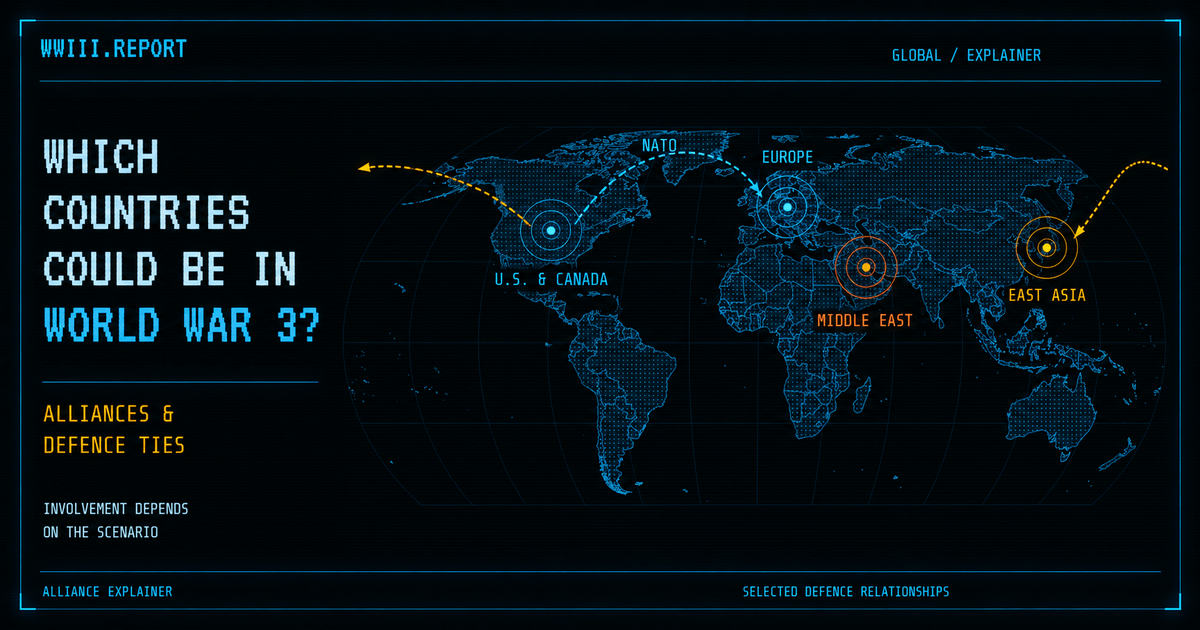
Which countries could be involved in World War 3?
The countries involved in a wider war would depend on where it began and how governments responded. NATO commitments, US alliances in Asia and foreign military bases help explain the possible roles.

World War 3 5 min read
How could World War 3 start? Five scenarios explained
A regional conflict could widen if major powers enter direct combat and fighting spreads across regions. Five scenarios explain how that could happen, and where diplomacy and restraint could interrupt escalation.