Emergency food storage: what to buy and how to preserve it safely
A useful emergency food supply covers meals your household can actually prepare. Learn what to store, how to rotate it, and the food-preservation mistakes that can make an emergency more dangerous.
Contents
A useful emergency food supply contains familiar food, safe water and meals that remain practical when power or deliveries are interrupted. Start with products your household already eats, check how they are prepared and build up supplies within your budget.
This approach is useful for conflict-related disruption as well as ordinary outages. The American Red Cross recommends three days of food for evacuation and two weeks for home use. Those are preparedness targets, not estimates of how long a war would last. Red Cross supply guidance.
What food should you buy first?
Begin with meals that need little preparation and can be eaten without electricity. New Zealand Civil Defence recommends keeping long-lasting food that does not need cooking, together with supplies for babies, animals and any special dietary needs. Household supplies guidance.
Use the following as planning examples, adjusting them for allergies, dietary requirements and the actual product label:
| Food type | Examples | Check before buying |
|---|---|---|
| Ready-to-eat protein | Canned beans, fish or meat; suitable nut or seed butter | Allergens, opening method and storage after opening. |
| Simple meal components | Crackers, shelf-stable bread products, ready-to-eat cereals | Whether everyone can comfortably eat them. |
| Fruit and vegetables | Canned produce and packaged dried fruit | Portion sizes and whether opened leftovers need cooling. |
| Longer-term pantry staples | Rice, pasta, dried pulses | Water, fuel and cooking time required. |
| Household-specific supplies | Foods already used for medical diets, infant feeding or pets | Correct preparation, quantities and storage conditions. |
Keep a manual can opener with supplies that need one. Choose some portions small enough to finish at a meal if refrigeration is unavailable.
Count meals, not just packages
Write a sample day's menu for your household. Then check whether you have enough of every ingredient, including drinking water and any water needed for preparation.
For example, four people eating three meals a day for seven days require 84 individual meals. That is a count of meal occasions, not a calorie prescription. A packet advertising 20 servings may represent much less than 20 complete meals; check its nutrition information and serving size.
Make a short inventory with the product, quantity, storage instructions and next review date. Use older suitable stock in normal meals and replace it. This makes preparation part of routine shopping and helps reveal foods nobody wants to eat.
How much water belongs with the food supply?
The CDC recommends at least one US gallon—about 3.8 litres—per person per day for three days, and a two-week supply if possible. It advises allowing more for hot conditions and certain household needs. This is a storage baseline covering drinking and other essential uses, not a personal fluid-intake target. Emergency water guidance.
Do the water calculation alongside the menu. A large supply of dried food is less useful if its preparation consumes water you have not stored.
What happens to food during a power cut?
Keep refrigerator and freezer doors closed as much as possible. FoodSafety.gov gives these approximate holding times:
| Appliance | Approximate time with the door kept closed |
|---|---|
| Refrigerator | Up to four hours. |
| Full freezer | Around 48 hours. |
| Half-full freezer | Around 24 hours. |
These estimates do not override measured food temperatures or food-specific advice. Discard refrigerated perishables after four hours without power unless you can establish that they remained at a safe temperature. If food has warmed, use the official chart's time-and-temperature rules. Never taste it to decide whether it is safe. FoodSafety.gov guidance and charts.
Can you preserve food at home for emergencies?
Yes, but the method must be suitable for the food and follow a tested process. Home preservation is a skill to learn with reliable guidance, working equipment and adequate supplies before an emergency.
For low-acid foods such as meat and many vegetables, ordinary boiling-water canning is not a safe substitute for pressure canning. The National Center for Home Food Preservation explains that incorrect processing can allow botulism toxin to develop. Use its tested instructions for the exact food, jar size and altitude. Canning safety guidance.
A closed lid alone does not prove food was processed safely. Do not taste suspect canned food or improvise a preservation recipe to rescue supplies that may already be unsafe.
What changes during a radiation emergency?
The CDC advises using protected food, including sealed containers, and wiping potentially contaminated packaging before opening it. Follow official instructions about outdoor produce and water supplies. Boiling water does not remove radioactive material. Ordinary spoilage rules still apply: packaging protected from fallout does not make spoiled food safe. CDC food and water guidance.
How can you prepare meals safely without mains power?
Make ready-to-eat meals your first option. Never use a camping stove, charcoal grill or portable generator indoors, including in a basement or garage: carbon monoxide can be fatal. Follow the appliance instructions and official placement guidance for any outdoor use. CDC carbon monoxide guidance.
For the wider connection between conflict, energy and deliveries, see our explainer on the Strait of Hormuz and global shipping. Household planning should address interruptions without assuming a particular conflict will cause a particular shortage.
Tags food guide prepping storage survival
SOURCES 8 · checked 24 Sep 2026
- Red Cross supply guidance redcross.org
- Household supplies guidance getready.govt.nz
- Emergency water guidance cdc.gov
- FoodSafety.gov guidance and charts foodsafety.gov
- Canning safety guidance nchfp.uga.edu
- CDC food and water guidance cdc.gov
- CDC carbon monoxide guidance cdc.gov
- the Strait of Hormuz and global shipping wwiii.report
READ NEXT
World War 3 10 min read
Europe’s survival guides: official advice for war and emergencies
Compare Europe’s official preparedness guides, from Sweden’s war brochure to Switzerland’s emergency supplies advice. Find resources for 31 countries and see how recommendations differ between 72 hours, one week and ten days.
World War 3 4 min read
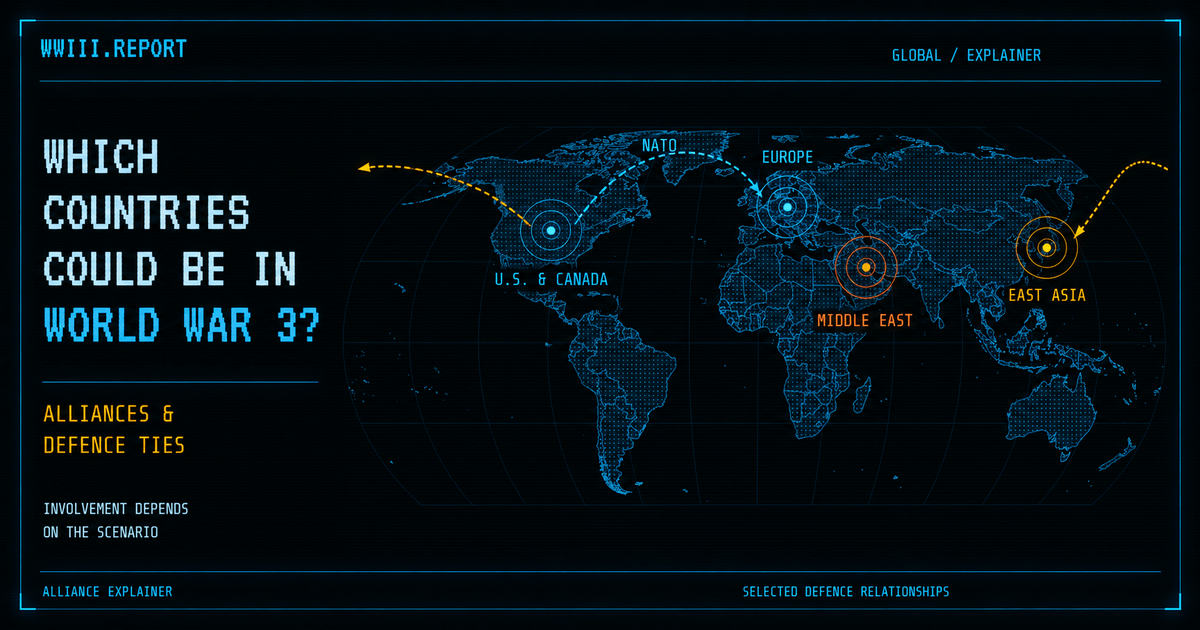
Which countries could be involved in World War 3?
The countries involved in a wider war would depend on where it began and how governments responded. NATO commitments, US alliances in Asia and foreign military bases help explain the possible roles.

World War 3 5 min read
How could World War 3 start? Five scenarios explained
A regional conflict could widen if major powers enter direct combat and fighting spreads across regions. Five scenarios explain how that could happen, and where diplomacy and restraint could interrupt escalation.