Which countries could be involved in World War 3?
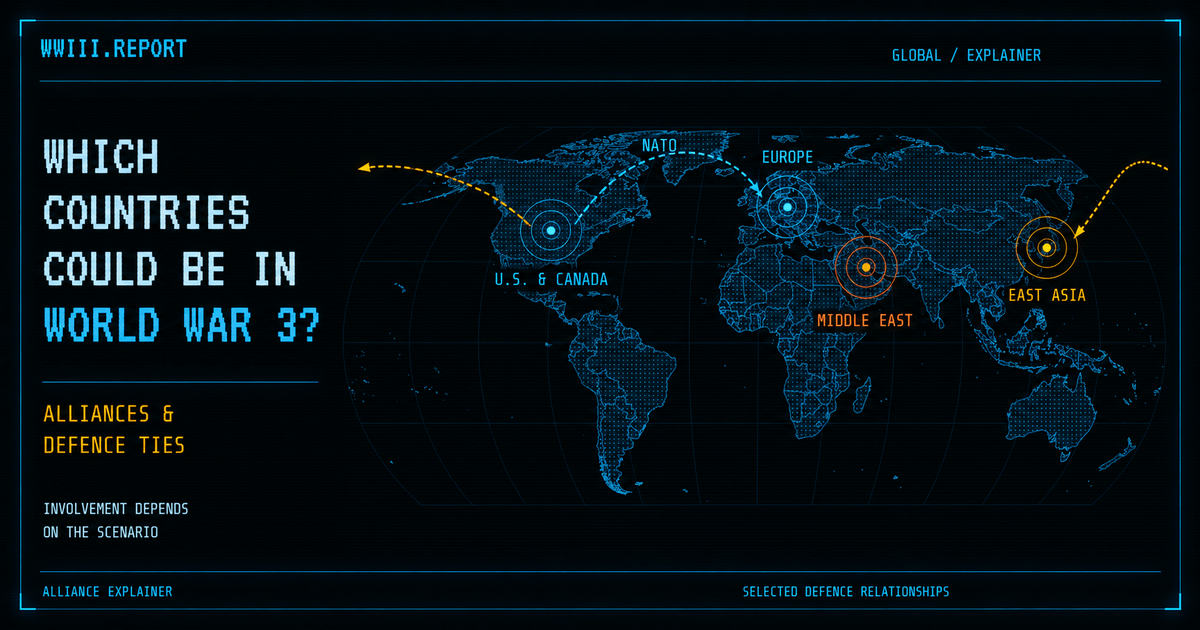
The countries involved in a wider war would depend on where it began and how governments responded. NATO commitments, US alliances in Asia and foreign military bases help explain the possible roles.
Contents
The countries involved in World War 3 would depend on how the conflict began. A Russia–NATO war would centre on Europe and North America. A Taiwan war would centre on China and Taiwan, with possible US and Japanese involvement. A Korean war or wider Middle Eastern war would bring a different set of states and commitments into play.
There is no fixed list of future combatants. There are, however, real defence treaties, military relationships and existing deployments that explain which countries could become involved.
The countries central to different scenarios
| Scenario | Central countries or territories | Why others could become involved |
|---|---|---|
| Russia–NATO war | Russia and NATO members, including the United States, United Kingdom, France, Germany and Poland | Collective-defence commitments and attacks affecting allied forces or territory. |
| Taiwan war | China and Taiwan, with possible US and Japanese roles | Decisions about intervention, access to Taiwan and defence of forces or territory. |
| Wider Middle Eastern war | Iran, Israel, the United States and affected regional states | Direct attacks, foreign military bases and commercial navigation. |
| Korean war | North Korea, South Korea and the United States | The US–South Korea alliance and the regional consequences of renewed fighting. |
| India–Pakistan war | India and Pakistan | Outside involvement could expand beyond mediation or military support. |
These are separate scenarios. Countries appearing in several rows would not necessarily take the same role in each.
NATO: a defence alliance with 32 members
NATO includes the United States and Canada, alongside European allies such as the United Kingdom, France, Germany, Poland, Finland, Sweden and the Baltic states. Finland joined in April 2023 and Sweden in March 2024, bringing membership to 32. NATO’s member list.
Article 5 creates an obligation to assist an ally subjected to a covered armed attack. Each ally determines the action it considers necessary; assistance can include armed force. The treaty does not prescribe an identical military response by every member. NATO’s Article 5 explanation.
This makes NATO a central part of any Russia–NATO scenario. It also explains why an attack on Ukraine, which is outside the alliance, has a different treaty position from an attack on Poland or Estonia.
The Russia–NATO timeline follows that relationship, including enlargement, consultations and defensive deployments.
Taiwan: US support does not work like NATO membership
Taiwan is outside NATO. The US relationship with Taiwan rests on a different policy and legal framework.
The Taiwan Relations Act provides for defensive arms and for maintaining US capacity to resist force or coercion against Taiwan. It does not itself require US forces to enter every conflict involving the island. Taiwan Relations Act.
That leaves consequential decisions in a crisis: whether the United States intervenes, in what form, and under what circumstances it expands or limits its involvement.
Japan matters because of its location, its US alliance and the facilities available to US forces there. The Japan–US Security Treaty addresses attacks against either party in territories under Japanese administration. An attack in Japan would therefore raise different treaty questions from fighting confined to Taiwan. Treaty text.
The China–Taiwan timeline provides the history behind those possible roles.
Korea: an established US–South Korea alliance
The United States and South Korea signed a Mutual Defense Treaty in 1953. It provides for consultation and for action against a common danger in accordance with each country’s constitutional processes. Treaty text.
A renewed war on the peninsula would therefore involve an existing defence relationship, rather than a coalition being invented from scratch. The extent of participation by other countries would depend on the course of the fighting and their decisions.
North Korea’s relationship with Russia is also relevant. NATO’s October 2024 confirmation of North Korean military deployment to Russia shows that the connection between the two governments extends beyond diplomatic statements. NATO’s deployment assessment.
The Middle East: direct combat, partnerships and host countries
The June 2025 sequence of US strikes in Iran and an Iranian attack on Al Udeid in Qatar illustrates the different roles. The United States conducted an attack; Qatar hosted the base subsequently targeted. Hosting foreign forces does not establish that the host government participated in every operation those forces conducted. Iran–Gulf timeline.
In a wider conflict, countries could become involved by defending their territory, protecting shipping or joining military operations. Others could mediate or provide humanitarian assistance. “Involved” therefore needs a description of the actual role.
The same caution applies to armed groups. Hezbollah, Hamas and the Houthis are distinct organizations. They should not be turned into state members of a single alliance on a hypothetical WW3 map.
Would every country have to choose a side?
No. Governments could remain outside direct combat while supporting sanctions, hosting negotiations or maintaining trade relationships. Some might cooperate with different countries on different issues.
People in those countries could still experience disrupted supplies, travel difficulties or higher import costs. Being affected by a war is much broader than being a combatant.
The useful picture is therefore a set of relationships that can change: who is fighting, who is supporting whom, which treaty applies and which additional decision would widen participation. The global tracker brings those regional developments together.
Tags Explainer Military alliances NATO World War 3
SOURCES checked 11 Sep 2026
- NATO’s member list nato.int
- NATO’s Article 5 explanation nato.int
- Taiwan Relations Act law.cornell.edu
- Treaty text mofa.go.jp
- Treaty text avalon.law.yale.edu
- NATO’s deployment assessment nato.int
From the tracker
READ NEXT

World War 3 5 min read
How could World War 3 start? Five scenarios explained
A regional conflict could widen if major powers enter direct combat and fighting spreads across regions. Five scenarios explain how that could happen, and where diplomacy and restraint could interrupt escalation.