NATO Article 4 vs Article 5: what is the difference?
Article 4 brings NATO members together when an Ally considers its security threatened. Article 5 creates a duty to assist after a covered armed attack. Neither sets an automatic military response to every incident.
Contents
- Article 4 and Article 5 compared
- What happens when a country invokes Article 4?
- When has Article 4 been used over Russia-related incidents?
- What triggers Article 5?
- Does every Ally have to send troops?
- Has Article 5 ever been invoked?
- Could a cyberattack qualify?
- How should readers interpret the next announcement?
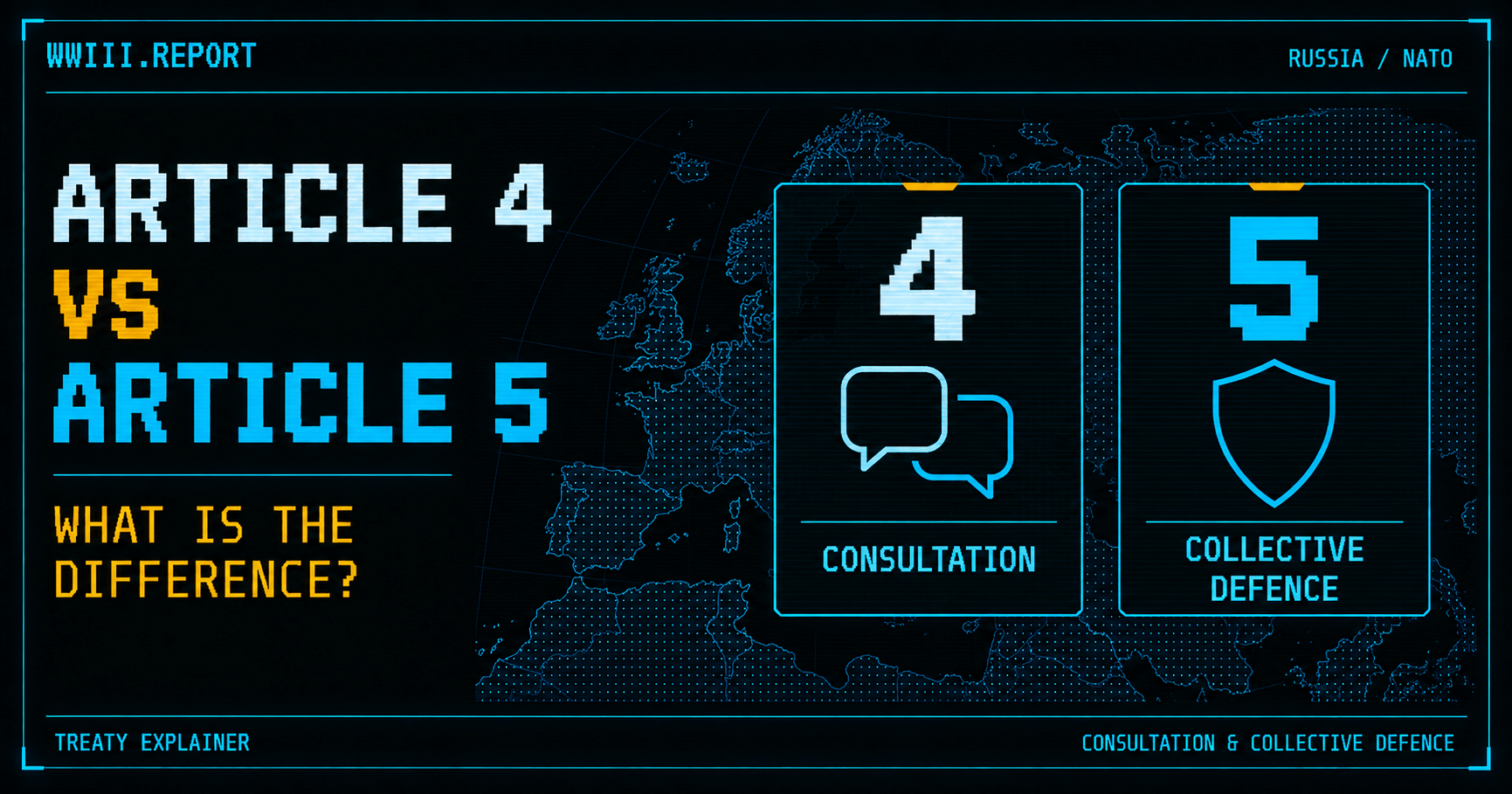
Article 4 is about consultation; Article 5 is about collective defence. Under Article 4, a NATO member can request discussions when it considers an Ally’s territorial integrity, political independence or security threatened. Article 5 creates a duty to assist after a covered armed attack, with each Ally choosing the action it considers necessary.
The two provisions come from the North Atlantic Treaty. Their numbers do not describe successive stages on a mandatory path to war.
Article 4 and Article 5 compared
| Question | Article 4 | Article 5 |
|---|---|---|
| What situation does it address? | A threat perceived by an Ally. | An armed attack covered by the treaty. |
| What is its purpose? | Consultation among members. | Assistance in collective defence. |
| Does it prescribe combat? | No. | No fixed response; armed force is one possibility. |
| Must Article 4 happen first? | It can be used independently. | Prior Article 4 consultations are not required. |
An emergency meeting can therefore be significant without meaning NATO has entered a war. Conversely, the absence of an Article 4 meeting does not remove the collective-defence commitment.
What happens when a country invokes Article 4?
The issue comes before the North Atlantic Council, NATO’s main political decision-making body. Allies exchange information, discuss the threat and consider possible measures. NATO decisions are made by consensus. NATO’s consultation guide.
Consultations can help establish a shared account of an incident. Governments may arrive with different information about an aircraft’s origin, a missile’s path or damage on the ground. Comparing those accounts can affect both the public explanation and the response.
The practical outcome depends on the circumstances. A statement of solidarity, additional protection or further monitoring may follow. Calling the meeting does not determine the result in advance.
When has Article 4 been used over Russia-related incidents?
NATO’s record includes consultations requested by eight Allies on 24 February 2022, following Russia’s full-scale invasion of Ukraine. Poland requested consultations again on 10 September 2025 after multiple Russian drones violated its airspace. Official Article 4 record.
Two days after the 2025 incident, NATO announced Eastern Sentry, an activity intended to strengthen its eastern-flank posture, including its response to drone threats. NATO’s announcement.
These examples show why consultation matters: it can lead to concrete defensive action. Describing Article 4 as “only a discussion” misses that potential, while describing it as a declaration of war misstates its purpose.
What triggers Article 5?
NATO’s published guidance identifies two conditions: an Ally has sustained a covered armed attack, and that Ally requests or consents to collective action. Whether an event constitutes an armed attack is assessed case by case. The Council meets to discuss the situation. NATO’s Article 5 guide.
There is no published rule that a particular number of drones, casualties or minutes inside national airspace automatically settles the question. The evidence and the nature of the event matter.
This makes the distinction between a threat and an established attack especially important. A government can seek urgent consultation while an investigation is still determining what happened.
Does every Ally have to send troops?
Article 5 requires assistance, but it does not prescribe an identical contribution from every member. Its wording leaves each Ally to determine the action it considers necessary, including the possible use of armed force. Treaty text.
That flexibility is different from having no obligation. It allows governments to contribute in different ways rather than promising that every country will deploy the same forces on the same timetable.
The treaty also defines the geographic scope of the commitment in Article 6. Membership should not be interpreted as making every incident involving a member, anywhere in the world, an identical treaty case.
Has Article 5 ever been invoked?
Yes. NATO invoked it after the 11 September 2001 attacks against the United States. NATO’s historical account describes subsequent measures including intelligence cooperation, surveillance flights and maritime activity. This demonstrates that collective defence can involve several kinds of assistance. NATO’s Article 5 history.
For a new crisis, rely on the Council’s actual statements rather than assuming that a reference to Article 5 means it has been invoked.
Could a cyberattack qualify?
Potentially. NATO says significant cyber or hybrid attacks can amount to an armed attack, with the assessment made case by case. The label “cyberattack” alone does not establish that threshold. NATO’s published guidance.
Attribution remains important: knowing a system was disrupted is different from establishing who was responsible and the wider nature of the attack.
How should readers interpret the next announcement?
Identify what has actually happened: a request for consultations, an assessment that an armed attack occurred, an agreed response or forces carrying out that response. Those are separate developments, even when they happen close together.
The Russia–NATO timeline puts earlier decisions in sequence. Use the theater report for later developments, keeping the treaty commitment separate from assumptions about what governments will do next.
Tags Article 4 Article 5 Collective defence Comparison NATO
SOURCES 6 · checked 20 Sep 2026
- North Atlantic Treaty nato.int
- NATO’s consultation guide nato.int
- NATO’s announcement nato.int
- NATO’s Article 5 guide nato.int
- Russia–NATO timeline wwiii.report
- theater report wwiii.report
READ NEXT
World War 3 4 min read
Which countries could be involved in World War 3?
The countries involved in a wider war would depend on where it began and how governments responded. NATO commitments, US alliances in Asia and foreign military bases help explain the possible roles.

World War 3 5 min read
How could World War 3 start? Five scenarios explained
A regional conflict could widen if major powers enter direct combat and fighting spreads across regions. Five scenarios explain how that could happen, and where diplomacy and restraint could interrupt escalation.