What is the Suwałki Gap, and why does it matter to NATO?
The Suwałki Gap is the border area linking Poland and Lithuania between Kaliningrad and Belarus. Its importance comes from land access to the Baltic states, collective defence and the civilian connections that cross the region.
Contents
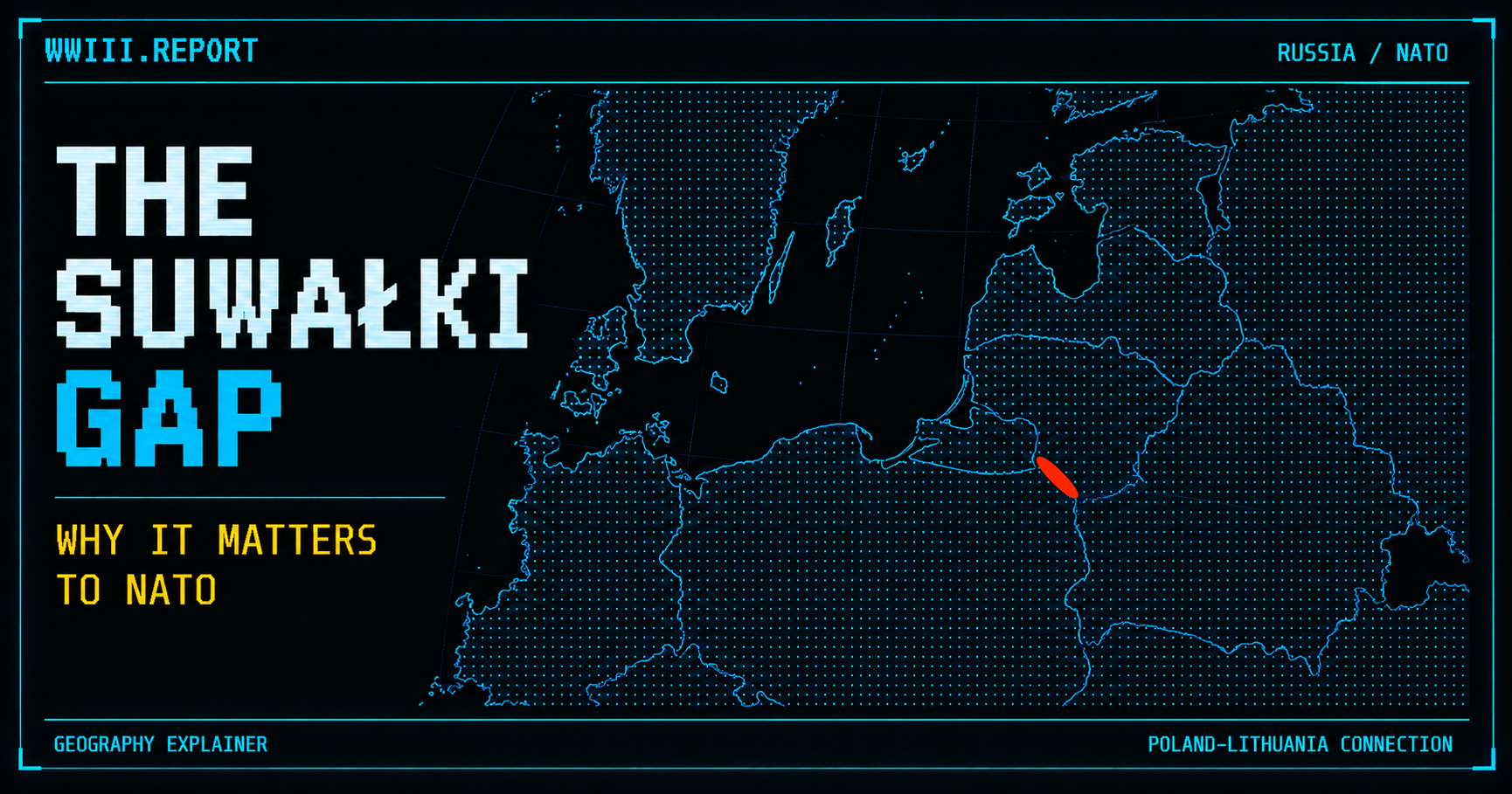
The Suwałki Gap is the border area between Poland and Lithuania, situated between Russia’s Kaliningrad region and Belarus. It matters because it provides the direct land connection from Poland to the three Baltic states: Lithuania, Latvia and Estonia.
The name appears frequently in discussions of a possible Russia–NATO conflict. It describes a geographic connection that defence planners must consider; it is not evidence that an attack has been decided.
Where is the Suwałki Gap?
The area takes its name from Suwałki, a town in northeastern Poland near Lithuania. Kaliningrad lies on one side and Belarus on the other. Kaliningrad is Russian territory separated from the main body of Russia, while Belarus is a separate state closely allied with Russia.
The gap itself crosses Polish and Lithuanian territory. It is not an ungoverned strip between the countries. Geographic background in Leopold Scholtz’s 2020 study.
| Place | Why it appears in explanations of the gap |
|---|---|
| Poland | Connects the border area to the wider European land network. |
| Lithuania | Connects Poland with the other Baltic states. |
| Kaliningrad | Russia’s separate Baltic region, bordering Poland and Lithuania. |
| Belarus | Russia’s ally on the other side of the border area. |
The strategic issue is access across this geography. A useful explanation does not require treating the whole region as a single road or an empty space on a map.
Why does the land connection matter to NATO?
Defending a country involves more than deciding to assist it. People, equipment and supplies have to reach the places where they are needed and remain available over time.
A disruption to the Poland–Lithuania connection could make land movement to the Baltic states more difficult. That is why the gap features in discussions of reinforcement and regional security.
It would not make the Baltic states disappear from the wider transport network. They also have maritime and air connections. The concern is losing or constraining an important form of access, with consequences for the alternatives that remain.
This distinction matters when reading headlines that suggest the Baltic states could simply be “cut off.” Ask which type of movement is being discussed, under what conditions and for how long.
How did NATO’s response develop?
At the July 2016 Warsaw Summit, NATO agreed to establish a multinational forward presence in Estonia, Latvia, Lithuania and Poland. The plan combined forces already present in those countries with the ability to reinforce them. Warsaw Summit Communiqué.
The Russia–NATO timeline places that decision within the wider deterioration in relations after Russia’s seizure of Crimea in 2014. It also records further defensive changes following the 2022 full-scale invasion of Ukraine.
NATO’s eastern-flank approach includes land forces, air and missile defence, maritime activity and reinforcement planning. This is a regional defence problem, rather than one that can be understood by looking at a single border area. NATO’s eastern-flank overview.
Did Finland and Sweden joining NATO change the picture?
Yes. Finland joined on 4 April 2023, and Sweden joined on 7 March 2024. Their accession added Allied territory and forces around the Baltic Sea and extended NATO’s collective-defence arrangements to both countries.
The implication for regional planning is a broader geographic setting for cooperation and support. An assessment made when both countries were outside NATO should therefore not be treated as a complete description of today’s alliance geography.
Their membership does not remove the Poland–Lithuania connection. Sea, air and land transport offer different capacities and face different constraints. Additional options can be valuable without making an existing route irrelevant.
Why is this also a civilian issue?
The region connects communities and economies as well as defence systems. Reliable cross-border transport helps people travel, businesses trade and essential goods reach their destinations.
Rail Baltica illustrates that wider purpose. Its official project description sets out the goal of integrating the Baltic states into the European rail network through Poland, with benefits for passengers, freight and military mobility. Those are project aims, not a claim that the complete new railway is already operating. Rail Baltica project overview.
Infrastructure that serves both civilian and defence needs is often called dual-use. Its value comes from supporting ordinary life while improving the ability to respond to a crisis.
Does the gap make a Russia–NATO war inevitable?
No. Geography helps explain why governments plan for a risk. It does not establish a decision to attack, the success of an operation or the response of other countries.
The 2020 study cited above explicitly presented theoretical scenarios. Its force figures and assumptions belong to that period; they should not be reused as a current military balance or a timetable for an attack.
Poland and Lithuania are NATO members, so an armed attack on their territory would directly concern NATO’s collective-defence commitment. The existence of a strategically important location does not, however, prescribe the course or outcome of a wider war.
For later incidents and decisions, see the Russia–NATO report. The Suwałki Gap’s lasting significance is the connection it provides and the need to keep that connection functioning during a crisis.
Tags Baltic security Military alliances NATO Suwałki Gap
SOURCES 8 · checked 20 Sep 2026
- Geographic background in Leopold Scholtz’s 2020 study scientiamilitaria.journals.ac.za
- Warsaw Summit Communiqué nato.int
- NATO’s eastern-flank overview nato.int
- Finland joined on 4 April 2023 nato.int
- Sweden joined on 7 March 2024 nato.int
- Rail Baltica project overview railbaltica.org
- Russia–NATO timeline wwiii.report
- Russia–NATO report wwiii.report
READ NEXT
Russia – NATO Tensions 4 min read
Will Russia attack NATO? Scenarios and evidence to watch
Russia–NATO tensions can escalate through deliberate attacks, spillover or miscalculation. Dated incidents and intelligence assessments explain the risks without turning military preparations into a prediction of war.
Russia – NATO Tensions 4 min read
NATO Article 4 vs Article 5: what is the difference?
Article 4 brings NATO members together when an Ally considers its security threatened. Article 5 creates a duty to assist after a covered armed attack. Neither sets an automatic military response to every incident.
World War 3 4 min read
Which countries could be involved in World War 3?
The countries involved in a wider war would depend on where it began and how governments responded. NATO commitments, US alliances in Asia and foreign military bases help explain the possible roles.