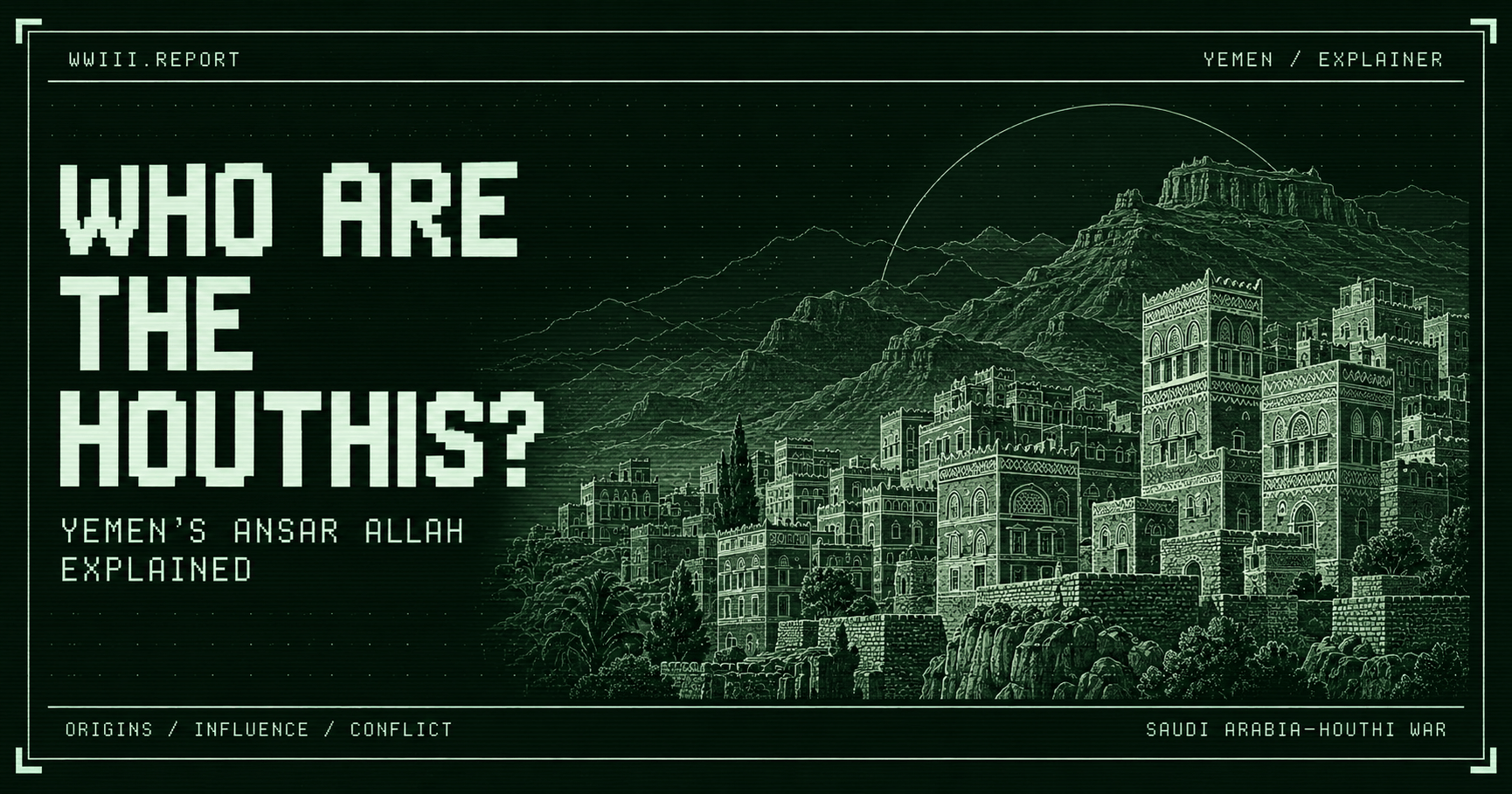
Who Are the Houthis? Yemen's Ansar Allah Explained
The Houthis are a Yemeni political and armed movement, also called Ansar Allah. Their rise connects local struggles for power with Saudi Arabia, Iran and Red Sea security.
Contents
The Houthis are a Yemeni political and armed movement formally known as Ansar Allah. They emerged in northern Yemen, captured the capital, Sanaa, in 2014 and became a central force in the country's war. They are aligned with Iran and have fought both Yemeni opponents and a coalition led by Saudi Arabia. S1 S2
Understanding who the Houthis are requires separating three things: the movement's origins, its authority inside Yemen and its military activity beyond Yemen's borders. A report about one does not necessarily explain the others.
Where did the Houthi movement come from?
The movement grew out of efforts to revive Zaydi religious and cultural traditions in northern Yemen. Zaydism is a branch of Shia Islam with a history distinct from the Twelver tradition dominant in Iran.
Hussein Badreddin al-Houthi, whose name became associated with the movement, challenged the government of President Ali Abdullah Saleh. Armed conflict between his followers and the Yemeni state began in 2004. Further rounds of fighting helped turn a local movement into an established insurgency. S1
Religion is part of that history, but religious identity alone does not explain the conflict. Disputes over political exclusion, state authority and representation also shaped the movement's rise. Zaydi Yemenis should not automatically be treated as Houthi supporters. S1
How did the Houthis become powerful in Yemen?
Yemen's political transition after the 2011 uprising failed to produce a stable settlement. The Houthis advanced beyond their northern base and took Sanaa in 2014. Their temporary alliance with forces loyal to former president Saleh strengthened their position, even though they had previously fought his government. The alliance later collapsed; Houthi forces killed Saleh in 2017. S3
They established a governing authority in territory they controlled. In July 2026, the Congressional Research Service described Houthi control over most of northwestern Yemen, including Sanaa. Yemen remained divided among rival authorities. S2
“Yemen,” “the Yemeni government” and “the Houthis” are not interchangeable terms. Using them interchangeably can wrongly attribute one faction's decisions to everyone living in the country.
What is the relationship between the Houthis and Iran?
Iran has provided military support that has helped the Houthis develop greater reach, particularly through missiles and drones. Their relationship also rests on shared regional adversaries and political interests.
However, describing the Houthis only as an Iranian proxy leaves out their Yemeni roots and domestic ambitions. CFR's analysis distinguishes Iranian support from complete Iranian control: the movement was not founded by Tehran and retains its own interests. Evidence of outside assistance does not, by itself, establish who ordered an individual attack. S4
Why does Saudi Arabia matter to their story?
Saudi Arabia intervened in 2015 to support Yemen's internationally recognized government, while seeking to counter a hostile, Iran-aligned force on its southern border. S5
This is why the Saudi Arabia–Houthi war is inseparable from Yemen's internal struggle, yet cannot explain every Yemeni dispute. Local forces have their own political goals, and opposition to the Houthis does not automatically mean agreement about Yemen's future.
What does Houthi rule mean for civilians?
Military control and public support are different things. Civilians living under Houthi authority cannot be assumed to endorse its actions.
The United Nations has condemned Houthi detention of UN and other personnel. In June 2026, the Secretary-General warned that these detentions harmed families and severely restricted humanitarian work. This makes civilian protection and access to aid essential parts of understanding the movement's role, alongside its battlefield influence. S6
Why are the Houthis discussed outside Yemen?
Their attacks on commercial shipping have brought Yemen's conflict into international trade routes. The International Maritime Organization tracks verified maritime incidents and has repeatedly condemned attacks that endanger seafarers, ships and cargo. S7
For continuing coverage of the Saudi Arabia–Houthi conflict, read our Daily Reports. For the sequence of major events, use the Saudi–Houthis War Timeline.
Sources
- S1: Council on Foreign Relations, Who Are Yemen's Houthis?, 25 February 2015. Historical origins, Zaydi identity and political development.
- S2: Congressional Research Service, Yemen: Conflict, Red Sea Security, and U.S. Policy, updated 21 July 2026; public reproduction at EveryCRSReport. Territorial context, Yemeni actors and changing Saudi–UAE relations.
- S3: Council on Foreign Relations, Conflict in Yemen and the Red Sea. Used for the 2014–2017 chronology and the historical expansion of cross-border attacks; the page contains sections of differing ages.
- S4: Council on Foreign Relations, Iran's Support of the Houthis: What to Know, updated 10 April 2026. Iranian assistance, local agency and the stated Gaza connection.
- S5: Council on Foreign Relations, Yemen's Tragedy: War, Stalemate, and Suffering, updated 1 May 2023. Political transition and reasons for the 2015 Saudi intervention.
- S6: United Nations, Secretary-General statement on two years of detention of UN and other personnel in Yemen, 10 June 2026.
- S7: International Maritime Organization, Red Sea area. Maritime safety and the verified-incident reporting process.
Tags Ansar Allah Explainer Houthis Iran Saudi Arabia Yemen
SOURCES 9 · checked 11 Oct 2026
- S1 cfr.org
- S2 everycrsreport.com
- S3 cfr.org
- S4 cfr.org
- S5 cfr.org
- S6 yemen.un.org
- S7 imo.org
- Daily Reports wwiii.report
- Saudi–Houthis War Timeline wwiii.report
READ NEXT

World War 3 5 min read
How could World War 3 start? Five scenarios explained
A regional conflict could widen if major powers enter direct combat and fighting spreads across regions. Five scenarios explain how that could happen, and where diplomacy and restraint could interrupt escalation.
World War 3 3 min read
What makes a conflict a world war?
A world war involves major powers fighting connected campaigns across regions. Foreign support and worldwide economic disruption can make a regional conflict internationally significant without turning it into a world war.
Russia – NATO Tensions 4 min read
Will Russia attack NATO? Scenarios and evidence to watch
Russia–NATO tensions can escalate through deliberate attacks, spillover or miscalculation. Dated incidents and intelligence assessments explain the risks without turning military preparations into a prediction of war.